A proposal for a monitoring and evidence service supporting the follow-through of the Trust Summit and the Nairobi Declaration on Trust and Call to Action.
Prepared for
Awel Uwihanganye, Chief Executive Officer, The Trust Summit
Submitted to
The Trust Summit Secretariat, Nairobi
Prepared by
Think Delus
Date
23 October 2026
Subject
Ten-week pilot of the Narrative Intelligence Desk
Validity
This offer remains open for 30 days from the date above. All prices are subject to confirmation.
47
items of Summit coverage collected and classified, 18 to 23 October 2026
23%
of keyword matches were false positives or other Nairobi Declarations
10
weeks for the pilot, with the exit stated at week 10
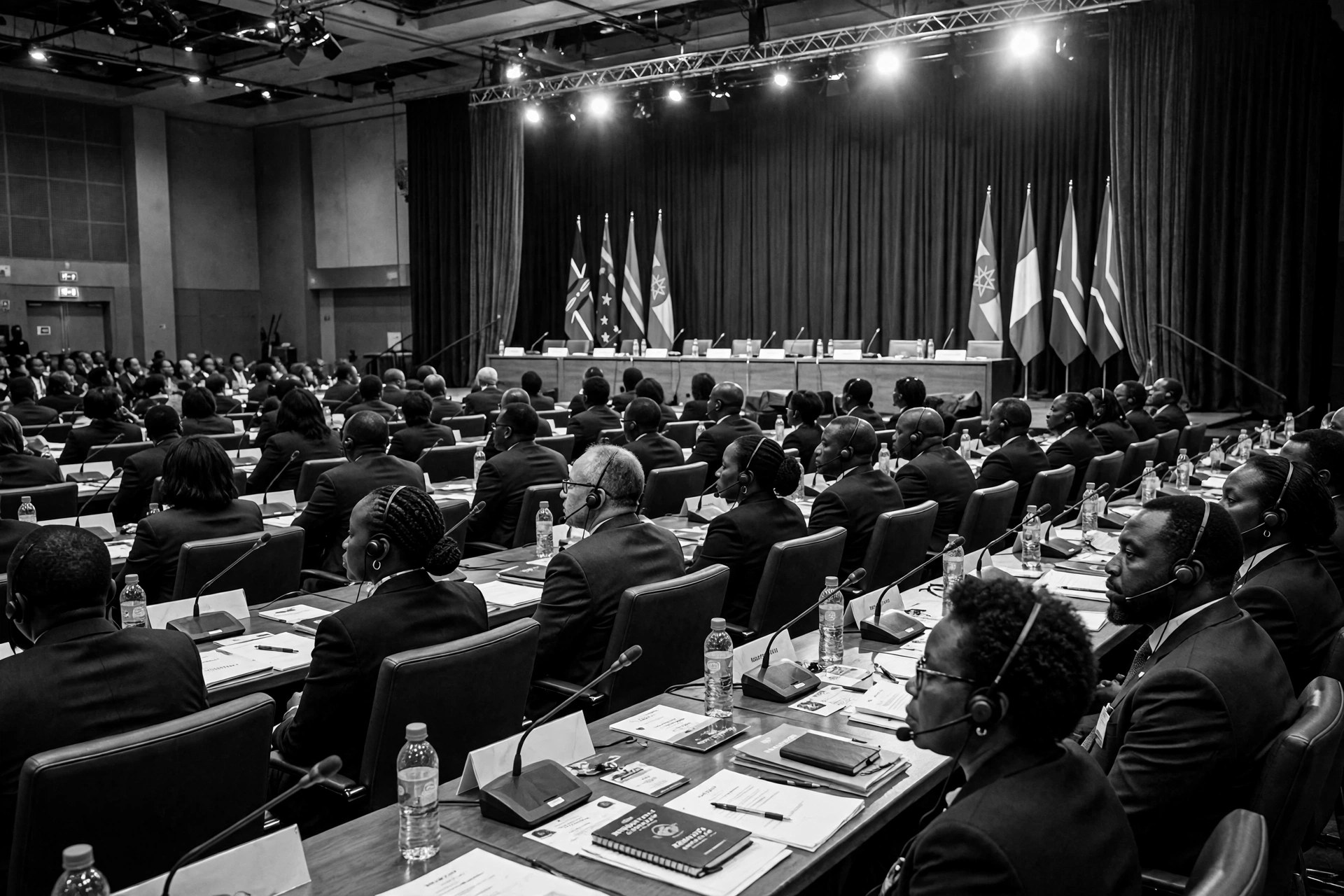
Illustrative image · A summit in session
This proposal is submitted on the initiative of Think Delus. Think Delus monitored the public record of the Summit; we did not attend it, and nothing in this proposal should be read as a claim of association with the Summit or its convenors. The evidence in sections 2 and 3 comes from a demonstration we ran on published coverage of the Summit, and any figure in it can be traced to a source file we hold and will share.
items collected across news, broadcast, official and social sources
31
signal items that concerned the Summit itself
42%
of signal came from the convenors’ own machinery: 13 of 31 items
3
items pressed the delivery question, among them The Eastleigh Voice and KICTANet
ND-02 · Requirement
2 Understanding of the requirement
The Nairobi Declaration on Trust and Call to Action, adopted on 23 October 2026, did more than record agreement. Its delivery steps create standing instruments. Paragraph 22 provides for a Coalition on Global Trust. Paragraph 23 provides for an inclusive Nairobi Trust Council, hosted by Kenya and drawn from the public, private and philanthropic sectors, to follow up and review progress on the commitments the Summit made.
The repair job the Summit set itself
Citizens
Trust between people, in daily dealings with each other
↔
Institutions
Trust between citizens and the bodies that serve them
↔
Global order
Trust between states, markets and multilateral bodies
Three relationships run through the Declaration and the Summit’s sessions. Each one is discussed in public, by name, and each public account needs a maintained record.
Paragraph 24 provides for a Global Trust Facility, championed for establishment by the United Nations, held and administered by UNDP and resourced from voluntary funds from state and non-state actors over four years. The Facility is to finance trust infrastructure, including national accreditation bodies, regulatory trust indices, data protection, cyber security authorities and judicial cooperation mechanisms. Commitments of that kind will be discussed in public, by name, for years.
Paragraph 22
A Coalition on Global Trust
A standing coalition to carry the Declaration’s commitments beyond the room in which they were made.
Paragraph 23
A Nairobi Trust Council
Hosted by Kenya and drawn from the public, private and philanthropic sectors, to follow up and review progress on the commitments themselves.
Paragraph 24
A Global Trust Facility
Championed for establishment by the United Nations, held and administered by UNDP, financing trust infrastructure over four years.
Paragraph 25
A Framework for Action
To be developed by the Secretariat, supported by a robust mechanism for monitoring, tracking and reporting on implementation and progress.
Paragraph 25 places the operational duty with your office: the Secretariat is to develop a Framework for Action, supported, in the Declaration’s words, by “a robust mechanism for monitoring, tracking and reporting on implementation and progress on a biennial basis”. Paragraph 28 confirms that the Summit convenes biennially, so the first reporting cycle runs to 2028. The Summit’s concept note names the delivery instruments that Framework will need: a Commitment Tracker holding validated commitments, named owners, milestones, status and evidence of progress; a Results Framework; a trust measurement instrument requiring technical validation, clear ownership and a defensible methodology; political-economy and risk analysis; and a RACI ownership map.
Oct 2026
The Summit closes. The Nairobi Declaration is adopted.
2026 to 2028
Follow-through runs in public. The record either exists, or it is rebuilt from clippings.
2028
First biennial reporting cycle. The account is written from the record that was kept.
Each of those instruments assumes a current, evidenced picture of the public account: what is being said about the Summit and its commitments, by whom, in what terms, and whether that account is holding. That picture does not currently exist as a maintained record. The requirement, as we understand it, is for an instrument that produces it continuously and can be cited without embarrassment. That is what this proposal offers.
ND-03 · Service
3 Proposed service
The Narrative Intelligence Desk is the record of what is being said about you, classified so you can act on it, with the sources to prove it.
The Desk monitors coverage of the Trust Summit and its follow-through, classifies each item by frame, and delivers a short cycle of products your team can use without further processing.
Sources, monitored daily
Web newsKenya and East Africa titles, online editions
Broadcast, published on the webStation pages, streams and clips
Official channelsSummit, government and partner properties
Social sourcesWhere platform access is licensed
→
The Narrative Intelligence Desk
Each item read, de-duplicated and classified against a written rubric: relevance, frame and tone, with its source attached.
→
Products, on a fixed cycle
Daily alert digest07:30 EAT, risks flagged with reasons
Weekly briefMondays 09:00 EAT, three to five pages
Corpus fileAll items, sources and classifications
Monthly frame reviewClassification tested with your team
Daily alert digest, 07:30 EAT
Anything published in the previous cycle that scores as a risk to the Summit’s commitments or reputation, with the source and the reason it was flagged.
Weekly brief, Mondays 09:00 EAT
Three to five pages. Coverage classified by frame: who is making the accountability argument, who is making the cost argument, who is amplifying the Summit’s own account, and who is scrutinising it.
The corpus file
It holds all items collected, with sources and classifications, so that any number in a brief can be traced to the item it came from.
Monthly frame review
A working session with your team in which our classification is tested against your own reading and adjusted where yours is better informed.
Specimen · Weekly brief, page oneDesk format, shown at reduced scale
Weekly brief: the Summit and its follow-through
Coverage classified by frame, with sources. Any figure traces to the corpus file.
Item counts by frame · Source and classification logged per item · Prepared for the Secretariat’s Monday reading
We have already run the method on your Summit
Between 18 and 23 October 2026 we collected and classified the public coverage of the Summit itself: 47 items across news, broadcast, official and social sources, each classified against a written rubric. Three results from that demonstration explain why the Desk is built the way it is.
Of keyword-matched items were not about this Summit at all: 11 of the 47 items collected. Seven were false positives on ordinary news. Four were collisions with other documents called a Nairobi Declaration.
The convenors’ own voice
Of signal coverage came from the convenors’ own machinery: 13 of 31 signal items. Independent coverage accounts for the remaining 18.
First-party, partner or amplification channels13 of 31
Independent coverage18 of 31
First, 23 per cent of keyword-matched content was not about the Summit at all. Seven items were false positives on ordinary news, and four were collisions with other documents called a Nairobi Declaration. A keyword monitor would have reported that quarter as coverage of your event. Second, 42 per cent of the genuine signal came from the Summit’s own properties, government channels, partner organisations and broadcasters’ amplification pages, so volume flatters the event and independent scrutiny is thinner than the count suggests. Third, only three items pressed the delivery question, among them The Eastleigh Voice and KICTANet. Those are the voices that will be quoted if delivery slips, and they are the ones the Desk watches most closely.
The Eastleigh Voice, reporting the Summit
“calls out gaps in Kenya’s public accountability”
KICTANet
“trust is not a soft skill”
The delivery question
3 items in 47 asked what happens next. The Desk watches those voices closest.
ND-04 · Method
4 Method and quality assurance
The Desk’s claim on your confidence rests on its method. Relevance, frame and tone are assigned against a written classification rubric, applied by analysts, and the rubric is available to your team on request. De-duplication and entity resolution happen before anything is counted, which is what removes the false positives and name collisions described above. The same item carried by six outlets is one item, and a different declaration with a similar name is a different subject.
STEP 01
Collect
Sources swept on a daily cycle, across the agreed source set.
→
STEP 02
Resolve
De-duplication and entity resolution run before any counting.
→
STEP 03
Classify
Relevance, frame and tone assigned against the written rubric.
→
STEP 04
Review and brief
Critical items checked by a second analyst, then issued with sources.
Any item classified as critical, or as a reputational risk, is reviewed by a second analyst before it reaches you. That two-person rule applies to the daily digest without exception, because an alert that is wrong costs more than an alert that is late. Once a quarter, 20 items are drawn at random and re-classified blind by an analyst who did not see the original classification. The agreement rate is published in the brief that follows the audit, and if it falls below 85 per cent the rubric is revised and the revision is recorded.
Quarterly blind audit: 20 items re-classified, agreement rate published in the following briefFLOOR 85%
Below the 85 per cent floor, the rubric is revised and the revision is recorded in the corpus file.
The correction promise
If we publish a factual error, we correct it within four working hours of the error being identified, and the correction is recorded in the corpus file so the record shows what changed and when.
ND-05 · Scope
5 Scope, exclusions and dependencies
✓ In scope for the pilot
One subject: the Trust Summit, the Nairobi Declaration and their follow-through.
Kenya and East Africa, across web news, broadcast content published on the web, official channels, and social sources where platform access is licensed.
The four products listed in section 3, at the stated times.
✗ Out of scope
Survey-based trust measurement and opinion polling.
Legal or defamation assessment, and takedown requests of any kind.
Crisis communications strategy. The Desk reports the record; the response belongs to your own team.
A boundary, stated in advance
We do not accept monitoring work on terms that require findings to be softened or withheld. A desk that sells the honest record cannot sell a favourable one.
The dependency that matters
Volume data from X and Meta is not included in this proposal. It depends on licensed platform API access, which the pilot price does not carry; where the Secretariat holds or obtains such access, or wishes us to, that coverage is available as a separately priced add-on described in section 7. Our demonstration was built without it, and the findings above stand on sources any reader can check.
ND-06 · Pilot
6 Pilot plan and timeline
The pilot runs for ten weeks from a start date we agree with you. It is long enough to establish a baseline, run two monthly cycles of the frame review in shortened form, and give your team a record it can judge.
Weeks 1 to 2Configure and baseline
Weeks 3 to 8Full operation
Week 8Formal review
Weeks 9 to 10Operate and decide
WEEK 1WEEK 5WEEK 10
Phase
What happens
Weeks 1 to 2
Configuration and baseline. Source set and search terms agreed with your team, the classification rubric calibrated against the Summit corpus, and a baseline brief issued covering the Summit period itself.
Weeks 3 to 8
Full operation. Daily alert digests, weekly briefs each Monday, and the corpus file maintained throughout.
Week 8
Review. A formal frame review with your team: the classification is tested against your reading, the source set is challenged, and we present the evidence for and against continuing.
Weeks 9 to 10
Operation continues. At the end of week 10 the Secretariat decides whether to end the pilot, extend it, or convert it to an annual contract at the rate in section 7.
The exit, stated plainly. The pilot ends at week 10 unless the Secretariat converts or extends it. There is no automatic rollover.
ND-07 · Commercial
7 Commercial terms
All amounts are in Kenya shillings and are subject to confirmation.
Setup and baseline, one-off
KES 220,000
Configuration, rubric calibration and the baseline brief covering the Summit period.
Monthly subscription, Desk tier
KES 295,000
Daily digests, weekly briefs, the corpus file and the monthly frame review.
Ten-week pilot, total
KES 900,000 approximately
220,000 setup plus ten weeks at the monthly rate. The pilot this proposal asks you to approve.
Annual contract, if converted
KES 3,540,000
Twelve months at the Desk tier rate, with a quarterly service review added.
Terms
Invoiced monthly in advance. The first invoice is issued on signature and includes the setup amount.
Minimum term three months. After the minimum term, either party may end the service on 30 days’ notice.
Platform API costs, where the Secretariat asks us to incur them, are passed through at cost plus 15 per cent and shown as a separate line on the invoice.
Changes to scope are handled as change orders, priced and agreed before the work is done.
Add-ons, priced separately
Add-on
Amount (KES)
Broadcast airtime monitoring and share of voice
240,000 per month, plus platform fees
Synthetic content and coordination check
180,000 per cycle
Crisis sprint, five working days
450,000
Additional subject
95,000 per month
Additional country
130,000 per month
Add-ons are never bundled into the pilot price. Each is taken only on the Secretariat’s written instruction.
Market context
For orientation, published prices for media monitoring and social listening tools vary by scope. Brand24 publishes plans from $199 per month billed annually for its Individual plan to $599 per month billed annually for its Business plan, with Enterprise from $1,499 per month billed annually. Mentionlytics publishes plans at $69, $169, $299 and $499 per month in its plan comparison table. BuzzSumo publishes its PR and Comms plan at $299 per month billed yearly. Meltwater publishes indicative starting points, from $10,000 per year for Starter and from $25,000 per year for Pro, and states that final pricing is confirmed through a scoping conversation. Cision, Brandwatch and Talkwalker publish no list price and route buyers to a pricing request, a demo or a custom quote.
These figures are for platform access on the terms stated by each provider. They do not include analyst time, briefing or reporting work, and the scope covered differs between providers.
Your named contact at Think Delus is Sammy Lusiola, Commercial Lead, who owns this engagement and attends the monthly frame review. Operational queries are acknowledged within one working day. A factual error in anything we have issued is corrected within four working hours of identification, as set out in section 4, and the correction is logged in the corpus file.
LEVEL 01
The Desk
Issues raised in the working relationship, answered at desk level first.
→
LEVEL 02
Commercial Lead
Sammy Lusiola takes any issue the Desk has left unresolved.
→
LEVEL 03
Director, Think Delus
A written account of the issue accompanies each step upward.
1 working day
Acknowledgement time for operational queries
4 working hours
Correction time for a factual error, logged in the corpus file
Week 8
Formal pilot review, with a quarterly service review added on conversion
If an issue is not resolved at desk level, it escalates to the Commercial Lead, and from there to a director of Think Delus, with a written account of the issue at each step. During the pilot, governance is the monthly frame review in section 3 and the formal review at week 8. On conversion to an annual contract, a quarterly service review is added, at which the audit results described in section 4 are tabled.
ND-09 · About
9 About Think Delus
Think Delus builds intelligence and monitoring systems for public-sector and regulated markets in Africa. We are based in Nairobi and deliver across Kenya, Tanzania, Ethiopia, Uganda and the wider region. Our clients include water utilities and a national water agency in Kenya, and broadcasters and donor programmes across five markets. The Narrative Intelligence Desk applies the same discipline as the rest of that work: a written method, a traceable record, and findings we are prepared to defend line by line.
Based in NairobiKenyaTanzaniaEthiopiaUgandaFive markets, broadcasters and donor programmes
Nairobi, our base
ND-10 · Acceptance
10 Acceptance
To accept this proposal and start the pilot, sign below and return one copy to Think Delus. On signature we issue the first invoice, including the setup amount, and agree the pilot start date with your team.
STEP 01
Sign
Both parties sign this page and return one copy to Think Delus.
→
STEP 02
First invoice
Issued on signature, including the setup amount of KES 220,000.
→
STEP 03
Start date agreed
The ten-week pilot clock starts on the date agreed with your team.
 THINK DELUS
 Illustrative image · A summit in session